Counterpart#
When two compact objects such as neutron stars (NS) or black holes (BH) merge, they can produce both gravitational-waves and electromagnetic signals. However, the nature and visibility of these signals depend strongly on the type of merging objects and the details of the event. This section explains what kinds of multi-messenger signals we can expect from different types of compact binary mergers, and how these observations reveal the physical processes at work in the most extreme environments in the universe.
What can we expect from different types of compact binary mergers?
Not all compact binary mergers emit both gravitational waves and electromagnetic signals. The type of signal we can expect depends on the components of the binary system:
Signals from Different CBC Type
Gravitational Waves: Strong, clear signals
EM Counterpart: None (no matter involved)
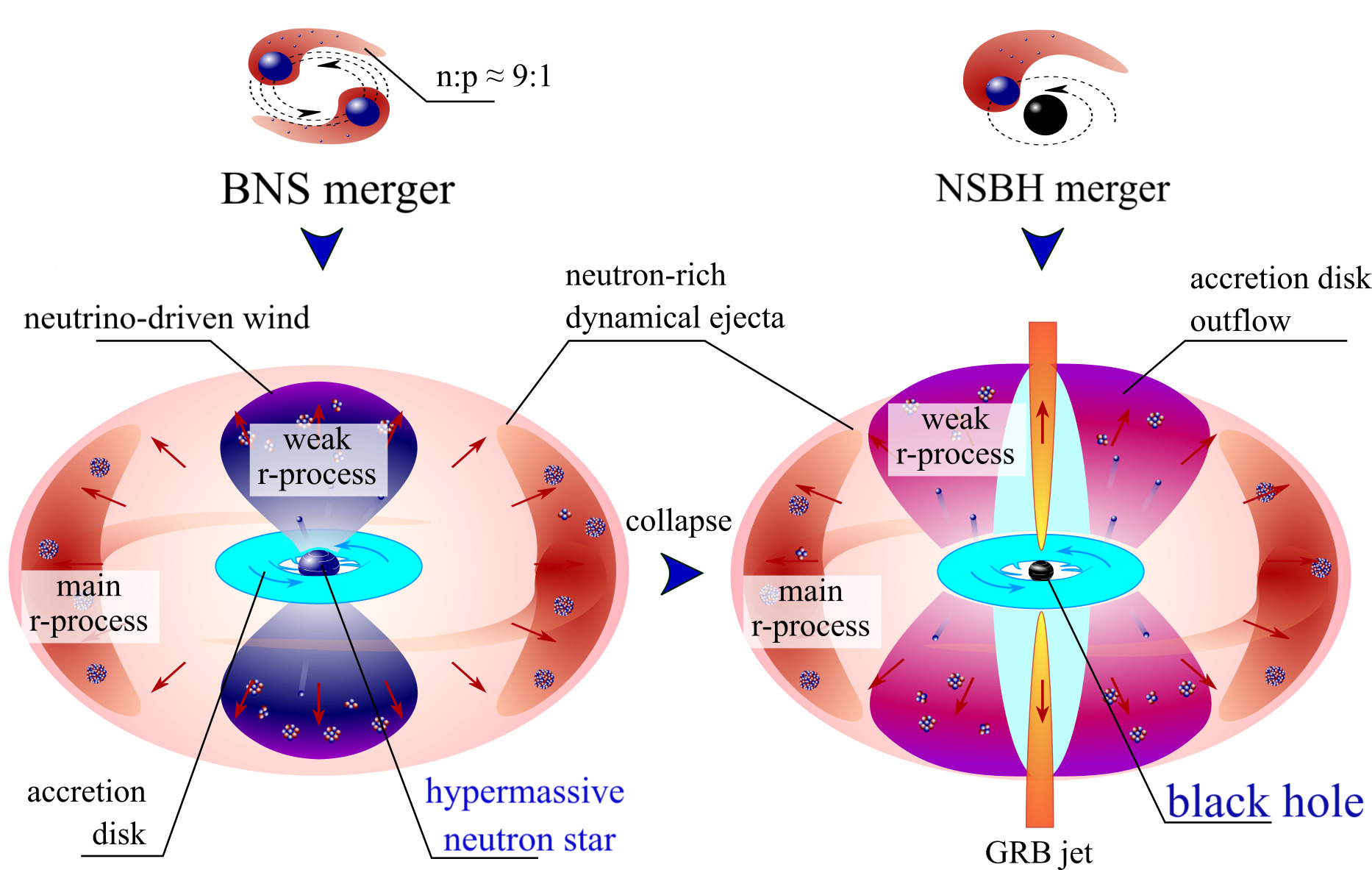
Multi-messenger outcome depends on the type of merger. Left: a BNS merger ejects matter from tidal tails and disk winds, producing both gravitational-waves and isotropic kilonova light. Right: in a NSBH merger, matter may be swallowed directly by the BH or ejected, depending on the system’s geometry. Only disrupted systems yield observable light.#
Credit: This figure is adapted from work by Matthew R. Mumpower
What about GW170817?
This BNS merger, detected in 2017, was the first confirmed multi-messenger event:
gravitational-waves detection by LIGO and Virgo
A short GRB (GRB170817A) detected simultaneously
A bright KN (AT2017gfo) observed from ultraviolet to infrared
Localized in galaxy NGC 4993 (~40 Mpc)
It revealed that neutron star mergers are key sites for the synthesis of heavy elements (gold, platinum) via the rapid neutron capture process \(r\)-process.
Note
The visibility of electromagnetic counterparts (especially KNe) depends on:
Gamma-ray Bursts
GRB are the most energetic explosions in the universe:
Short GRBs (< 2 seconds, harder gamma-ray spectra) result from CBC involving neutron stars (e.g., GW170817).
Long GRBs (> 2 seconds, softer gamma-ray spectra) result from the collapse of massive stars.
GRBs are extremely bright, detectable across electromagnetic wavelengths, from gamma-rays to optical and NIR afterglows.
Kilonovae
KNe are transient astrophysical phenomena emitting from UV to IR wavelengths, following NS mergers (BNS or NSBH). These events:
Produce heavy elements via \(r\)-process nucleosynthesis (e.g., gold, platinum).
Emit relatively isotropic EM radiation, unlike the highly directional GRBs.
Offer clues about neutron star interiors, dense matter physics, and cosmic chemical evolution.
The brightness and color (blue vs. red KNe) depend primarily on the ejected matter’s electron fraction (Ye):
Blue kilonovae (Ye > 0.25): Lanthanide-poor, less opaque ejecta emitting at shorter wavelengths (visible and UV).
Red kilonovae (Ye < 0.25): Lanthanide-rich, highly opaque ejecta emitting primarily at longer, IR wavelengths.
Multi-wavelength Observations
Observations across multiple wavelengths are essential to fully characterize merger events:
Ground-based observatories: ZTF, LSST for optical follow-up.
Space-based observatories: Swift (GRB), JWST (infrared), upcoming ULTRASAT (UV).
GW detectors: LIGO-Virgo-KAGRA (ground-based), LISA (future space-based detector).
Important
Combining gravitational-waves with electromagnetic signals from compact binary mergers allows astronomers to:
Probe extreme physics and dense matter properties in neutron stars.
Understand cosmic nucleosynthesis and the origin of heavy elements.
Refine cosmological parameters, including the expansion rate of the universe.
Multi-messenger astronomy promises transformative insights into the most energetic and mysterious phenomena in our universe.